Follow this link to skip to the main content
National Aeronautics and Space Administration Jet Propulsion Laboratory
California Institute of Technology
Cryospheric Sciences Program: Tools for managing a scarce resource.
Missions and Instruments
SHARE  |  EMAIL  |  PRINT

CRYOSPHERIC SCIENCE MISSIONS

IN ORBIT  |  PLANNED  |  PAST  |  OTHER PROGRAMS

The following is an alphabetical list of NASA satellites and instruments that observe Earth's cryosphere.

Aqua carries six state-of-the-art instruments to observe the Earth's oceans, atmosphere, land, ice and snow covers, and vegetation, providing high measurement accuracy, spatial detail, and temporal frequency. This comprehensive approach to data collection enables scientists to study the interactions among the four spheres of the Earth system--the oceans, land, atmosphere, and biosphere. AQUA
Aqua carries six state-of-the-art instruments to observe the Earth's oceans, atmosphere, land, ice and snow covers, and vegetation, providing high measurement accuracy, spatial detail, and temporal frequency. This comprehensive approach to data collection enables scientists to study the interactions among the four spheres of the Earth system -- the oceans, land, atmosphere, and biosphere.

Instruments: AIRS * AMSU-A * AMSR-E * CERES * HSB * MODIS

 Mission home page
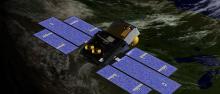
Earth Observing-1 (EO-1) is an advanced land-imaging mission that will demonstrate new instruments and spacecraft systems. EO-1 will validate technologies contributing to the significant reduction in cost of follow-on Landsat missions. EARTH OBSERVING-1 (NMP)
Earth Observing-1 (EO-1) is an advanced land-imaging mission that will demonstrate new instruments and spacecraft systems. EO-1 will validate technologies contributing to the significant reduction in cost of follow-on Landsat missions.

 Mission home page
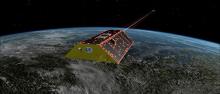
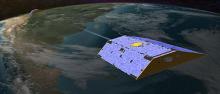
The Grace mission GRACE
The twin Gravity Recovery and Climate Experiment (GRACE) spacecraft observe and measure the gravitational field of the Earth. The findings from this mission shed light on the shape and composition of the planet and the distributions of water and ice. The mission was launched in March 2002.

 Mission home page
LAGEOS, or Laser Geodynamics Satellites, are a series of satellites designed to provide an orbiting benchmark for geodynamical studies of the Earth. LAGEOS 1&2
LAGEOS, or Laser Geodynamics Satellites, are a series of satellites designed to provide an orbiting benchmark for geodynamical studies of the Earth.

 Mission home page
Landsat 7 concept Landsat-7
Landsat 7 systematically provides well-calibrated, multispectral, moderate resolution, substantially cloud-free, Sun-lit digital images of the Earth's continental and coastal areas with global coverage on a seasonal basis. It covers the United States every 16 days.

 Mission home page
Terra (formerly EOS AM-1) is the flagship satellite of NASA's Earth observing systems. Terra is the first EOS (Earth Observing System) platform and provides global data on the state of the atmosphere, land, and oceans, as well as their interactions with solar radiation and with one another. TERRA
Terra (formerly EOS AM-1) is the flagship satellite of NASA's Earth observing systems. Terra is the first EOS (Earth Observing System) platform and provides global data on the state of the atmosphere, land, and oceans, as well as their interactions with solar radiation and with one another.

Instruments: ASTER * CERES * MISR * MODIS * MOPITT

 Mission home page


Cryospheric Sciences Program
NASA's Global Climage Change | Feedback | Site Map | Privacy
Site Manager:  Randal K. Jackson
Webmaster:   Cecelia Lawshe